
Article #44 – Art – Silence – Grace
By Arrachme
Students often ask, “Must every inch of a canvas be filled? What happens if we leave the white space to speak instead?” When visiting a gallery or museum, do you notice the quiet places in a work of art? Do you make a value judgment? Are they lesser than the busier, more elaborate artworks, or do they offer something else, something deeper?
Throughout history, many artists have explored these very questions. They’ve left portions of their canvases untouched, placing only a few intentional lines or shapes, and then stopping. One of my most beloved artists, Joan Miró, often worked this way. It took me four times to arrive at the Fundación Joan Miró in Barcelona, Spain, when they were open, to experience the stillness and power of his pieces in person. The experience was well worth the wait. His artworks often lean toward minimalism. With a simple arrangement of lines and colors, he says all that needs to be said, allowing the rest of the canvas to breathe.
The role of absence in art has been vital to the evolution of avant-garde movements. From Robert Rauschenberg’s blank canvases, which dared the viewer to question the very definition of art, to Franz Kline’s bold, expressive strokes that emphasize what there isn’t, as much as what there is, artists have long explored silence and space. This type of painting may seem simple, such as repeating circles, but I assure you, the execution can be challenging. Then there is the quiet brilliance of Agnes Martin, whose minimalist grids pulse gently with subtle variation and emotion. These works, while seemingly sparse, are full of feelings. At first glance, they may appear extreme or even empty. But when one sits with them, truly sits, a quiet, settles in. From that quiet, grace emerges.
The busy mind wants stimulation, color, or motion. It wants something to decode or admire. When presented with a minimalist canvas full of white or neutral space, the mind can become restless. In a row of paintings, it might hurry past or simply not notice the painting at all. Painting a minimalist work, with an abundance of silent space, can be difficult, but is worth the learned skill, thus appealing to a refined viewer. The opposite is painting a beautifully simplistic seascape; the busy mind will not rest until a beach chair or a boat is added in as a focal point, thus reducing the overall original sophistication of the painting.
Music, art in sound, has been a deeply personal experience for both the creator and the listener. For me, sound has been challenging. Certain frequencies or notes have caused migraines so severely that they’ve led to blackouts. What others may experience as beautiful or comforting, I can experience as overwhelming, quickly moving to physical pain. Due to heightened sensitivity, I don’t hear music as most people do; I feel its vibration more than its melody. This is true for most sounds in my life. Other artists may experience this to some degree, but not understand why.
And yet, I have found beauty in sound, particularly in silence, and in the spaces between sounds. One of the most moving auditory experiences I’ve ever had came from the Japanese shamisen. Described as a deliberate plucking on a string, followed by long, meaningful pauses. There is as much music in the silence as in the notes. The rhythm of sound and silence creates a space to rest. In that space, we find grace. It feels remarkably like looking at a minimalist painting. Each element is intentional, and each absence is full of meaning.
The included piece, Wild Citizen 6, is from my Wild Citizen series. Each painting includes an impression of a happy bird and a simple shape of gold leaf. The rest of the canvas is silent, filled with a neutral color.
So the next time you visit a museum, I hope you will notice the silent spaces and stay long enough to enjoy the grace.
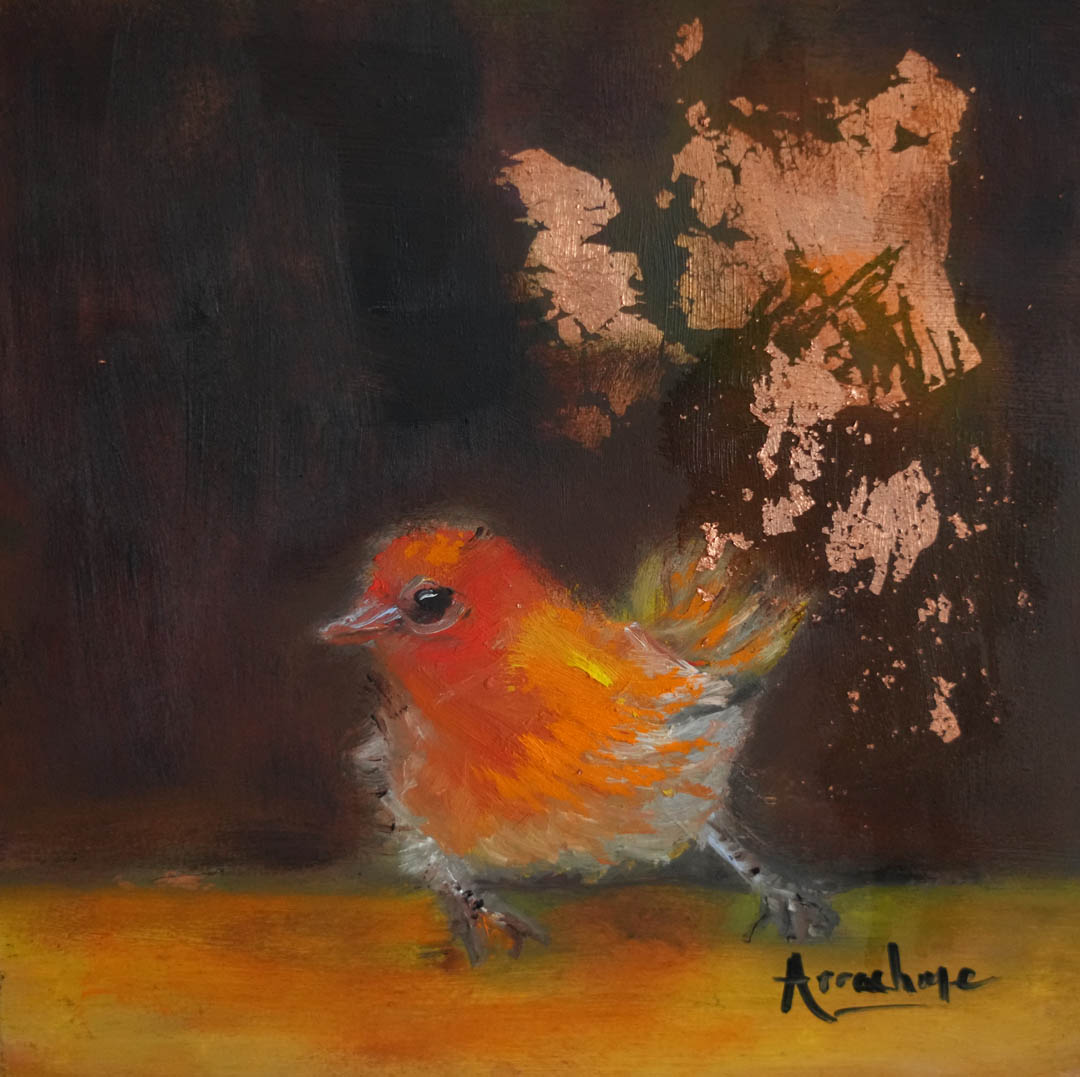
Wild Citizen 6