Article #45 – Will AI Replace Artists
By Arrachme
Are artists becoming obsolete? This is a question that I am often asked. The answer lies in understanding how different forms of art are created. Is AI-generated art a foe or a friend to the individual artist? The answer will lead to a revealing, and perhaps surprising, conclusion. Automation has long played a role in the artistic process for centuries. Some respected researchers speculate that the Dutch artist Johannes Vermeer may have used a camera obscura to create his iconic painting The Girl with the Pearl Earring in the 1600s. Later, in 1895, the “magic lantern”, an early image projector, was developed to help artists draw more accurately. Many remember schoolteachers using modern overhead projectors to get their point across.
Fast forward to current times. Today, we find ourselves surrounded by far more advanced tools: 3D printers, AI-generated collages, digital overlays, and drawing aids. It’s fair to say that these tools make it easier for some types of art to be completely replicated by machines. For instance, artworks that rely on repetitive, precise mark-making, often found in technical drawing, photorealism, or certain types of graphic design, are particularly susceptible to automation. Today, murals and large-scale designs can be digitally printed and installed without a paintbrush. In these cases, the artist becomes more of a technician, working on computers. We have seen these tools used to touch up photography become a mainstay, or even completely overpower the original photograph.
This shift may influence traditional media such as graphic design, photography, colored pencils, and watercolor. Watercolor holds a special place in art history, famously favored by royalty. While the initial sketch often used in watercolor painting may be replicated by machines, it seems that the expressive spontaneity and unpredictable nature of the loose liquid paint can remain a uniquely human challenge.
What Will Remain?
The most unshakeable form of art remains abstraction. It continues to resist replication because it is the most difficult style to master. What makes it so hard?
Creating fine abstract art involves a deep understanding of three complex steps. First, an artist must master the elements and principles of design. These are skills that often take years to develop through formal education. Second, they must experiment boldly, using what they have learned while adding and subtracting mediums like a chemist. This is explained by combining materials to form a personal visual language. Third, they must study the work of others, critically analyzing how design principles have been applied and learning to identify successful combinations until they develop a unique personal visual voice. The skill to automatically identify and critique all forms of art is the only way to be able to critique one’s art. Properly critiquing is the secret that allows one to leap forward into the professional world.
Make a personal challenge by quietly attending art exhibits from the MOMA (Museum of Modern Art) to local craft fairs. The artist will know when they have mastered the three steps. Hint – judging and critiquing are two different things. Only after completing this journey can an artist create a cohesive body of abstractions that reflect their unique, deeply personal style. This style comes from within. It is shaped by experience, education, intuition, and emotion. Machines cannot fully replicate it.
Seasoned collectors, museum curators, and art dealers evaluate artwork by looking for consistent and intentional mark-making. The artist who has eliminated confusion will be armed with more confidence. This is important. As our world becomes more AI-generated, personalized deception will become ‘a thing’. Ironically, if the experts have not deeply studied the aforementioned creative process, they may struggle to tell whether a painting was made by a human hand or generated by AI. No longer is it as easy as looking for an organic brush stroke.
At its core, art is more than a series of techniques. True artistic expression, born from the human spirit, education, and passion, cannot be replicated overnight or by a machine.
In conclusion, after seeing rapid changes in the art world, the answer is yes. It seems to me that many types of current art forms will become obsolete. Trendy technique-based art will come and go, selling, then disappear into the local garage sale.
The older master artists with clear, distinct styles will become even more valuable, but this group will narrow down substantially. Change, due to AI-generated paintings, drawings, photography, videography, and even 3-D printing, will without a doubt change, become obsolete, and then evolve into something so amazing that we cannot comprehend it at the current moment.
What Should an Artist Do?
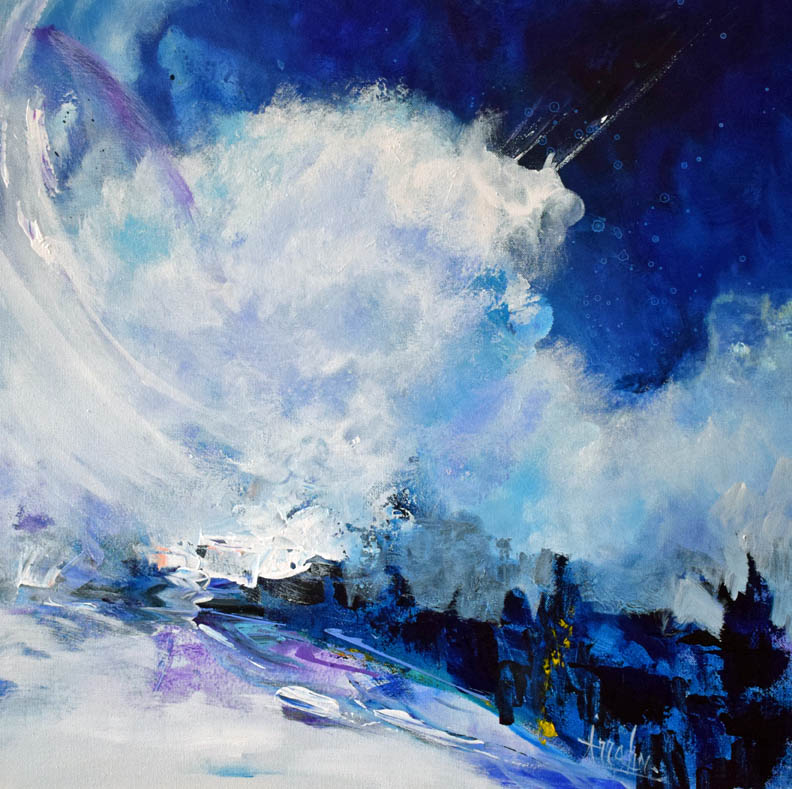
All budding painters should learn the most important factors mentioned above that will assist in creating unique paintings with their distinct marks. Most of all, they should have fun and not worry about AI-generated art. Take care of oneself, and the world will take care of itself. My included painting, ‘Expanded Timeline’ is an example of an abstraction. It has minimal color variation because it relies heavily on identifiable marks.